Saturday, November 23, 2013

Obama administration pondering new carbon emission pledge in wake of Warsaw climate change conference

warsaw.jpgThe Obama Administration is planning to introduce a pledge to make additional steep cuts in U.S. carbon emissions after 2020 in the wake of a little-noticed United Nations conference on greenhouse gas emissions that is the latest step toward a new treaty to take the place of the tattered Kyoto Protocol.
Just how dramatic the American pledge will be is not yet clear. A U.S. official at the conference taking place in Warsaw —who declined to be quoted directly—told Fox News that an amorphous White House inter-agency consulting process was still considering what the next U.S. reduction should be, and wasn’t yet ready to put a hard number on the table.
Whatever it is eventually revealed to be, the next emissions reduction target will be introduced into the labyrinthine, U.N.-sponsored treaty process as itinches along for two years after the Warsaw meeting that is slated to end Friday. It will supposedly culminate at yet another major climate session in Paris in December 2015, where the successor treaty will—supporters hope—be adopted.
The administration itself says that its forthcoming emissions targets—and continuing staunch support for the war against “climate change”—are intended help to kick-start a virtuous competition among nations, spurred on by interest groups, hosts of non-government organizations, and the sprawling global network of United Nations organizations to push the faltering climate process away from the ditch of disinterest where it has increasingly been heading.

That virtuous competition is part of a new, smorgasbord-style approach that the U.S. is promoting for future pledges, “ to ensure that each Party is constructing a commitment that reflects its national circumstances and full capabilities,” as the administration puts it in a conference submission

Senate's Nuclear Option Raises Stakes For 2014

 WASHINGTON -- Senate Majority Leader Harry Reid made one party in the Senate significantly more powerful when he ended filibusters on presidential appointments Thursday -- and instantly elevated the importance of the 2014 Senate elections.
"It raises the stakes," said Sen. John McCain (R-Ariz.), who has often remarked that "elections have consequences."
The one-time GOP presidential nominee also admitted that the ability Reid exercised to break the Republican blockade of President Barack Obama's nominees was one of those consequences.
"I'm afraid so," McCain said.
Led by the Nevada Democrat, the Senate voted 52-48 Thursday to wield the "nuclear option," eliminating the ability of the Senate minority to filibuster executive branch nominees and any judgeship below the Supreme Court by changing the requirements for passage to a simple majority vote. And now, thanks to Reid's power move, the stakes for 2014 include control of a Senate that can either be a stronger aid to Obama in the furtherance of his agenda or, if the GOP can take over, an even more effective check on the executive's ambitions.
Senate Minority Leader Mitch McConnell (R-Ky.) suggested just that immediately after Thursday's vote to change the rules, announcing that he intended to strike back at the polls next fall.
"The solution to this problem is at the ballot box," McConnell rather pointedly told reporters on Capitol Hill. "I look forward to having a great election in November 2014."

Republicans need to win six seats next fall to take over the upper chamber, and the map remains a tough one for Democrats, who have to defend 21 seats, compared to just 14 for the GOP. And seven of those Democratic seats are in states that lean Republican, with a couple more in swing states.

EU spokesman: Iran nuclear deal reached

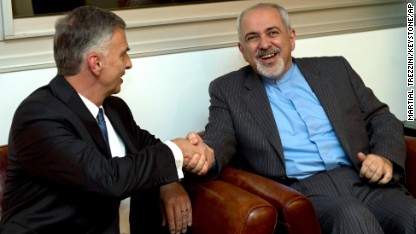
Geneva, Switzerland (CNN) -- An agreement was struck early Sunday between Iran and six world powers over Tehran's nuclear program, a spokesman for the European Union said.
The historic deal follows marathon talks to overcome issues surrounding the wording of an initial agreement over Iran's nuclear development program and lift some sanctions while a more formal deal between the two sides is worked out.
"We have reached agreement," EU spokesman Michael Mann said in a Twitter post.
For years, Iran and Western powers have left negotiating tables in disagreement, frustration and at times open animosity.
But the diplomatic tone changed with the transfer of power after Iran's election this year, which saw President Hassan Rouhani replace Mahmoud Ahmadinejad.
Caustic jabs at the United States and bellicose threats toward Israel were a hallmark of Ahmadinejad's foreign policy rhetoric.
He lambasted the West over the economic sanctions crippling Iran's economy and at the same time, pushed the advancement of nuclear technology in Iran.
Rouhani has struck up a more conciliatory tone and made the lifting sanctions against his country a priority

Monday, October 28, 2013

Federal judge blocks key parts of Tex. anti-abortion law Monday

Lenell Ripley, second from left, cries as she demonstrates with other abortion rights supporters outside the Capitol auditorium in Austin, Texas, Thursday July 18, 2013. (AP Photo/Austin American-Statesman, Jay Janner) A federal judge in Texas blocked two key parts of the state’s controversial antiabortion law Monday, ruling that one part is unconstitutional while another provision imposes an undue burden on women in some instances.
The ruling by U.S. District Judge Lee Yeakel represents a legal victory for abortion rights providers, who had challenged new requirements that abortion doctors must have admitting privileges at a hospital within 30 miles of their clinic and that all abortions must take place in surgical centers, rather than allowing women to take abortion drugs at home.
Texas attorney general Greg Abbott spokeswoman Lauren Bean said the state immediately appealed the ruling.

Eleven abortion clinics and three doctors filed a federal lawsuit last month saying that the requirements, which were due to take effect Oct. 29, would end abortion services in more than a third of the state’s licensed facilities and would eliminate services altogether in Fort Worth and five other major cities. Abbott had argued the new restrictions, adopted this summer, were aimed at providing better medical protections for both women and their fetuses.

Americans Think Everyone's Doing A Terrible Job Handling Health Care

health care poll
While Americans largely disapprove of how President Barack Obama is handling health care, according to a new HuffPost/YouGov poll, they have even more negative opinions of how Republicans in Congress are handling the issue.
According to the new poll, Americans disapprove of Obama's handling of health care by a 56 percent to 39 percent margin. The survey also finds that 47 percent want to see the Affordable Care Act, Obama's signature health care law, repealed, while 25 percent want to see it expanded and 15 percent think it should be kept the same.
But few view Republicans in Congress as saviors -- by a 63 percent to 27 percent margin, most disapprove of their handling of the issue. Congressional Democrats fared slightly better, though a majority still viewed them negatively, with 34 percent approving and 53 percent disapproving of their handling of health care.

And if forced to choose, more Americans trust Obama to handle health care than Republicans in Congress, 42 percent to 33 percent. Twenty-five percent said they weren't sure.

McAuliffe opens up double-digit lead over Cuccinelli in Virginia governor’s race

Democrat Terry McAuliffe has opened a double-digit lead over Republican Ken Cuccinelli II in the race for Virginia governor, in a new poll capturing increasing dissatisfaction among voters with Cuccinelli’s party and his conservative views.
According to a new Washington Post/Abt SRBI poll, McAuliffe tops Cuccinelli 51 percent to 39 percent among likely voters in the Nov. 5 election. McAuliffe led by eight percentage points in a poll taken last month. Libertarian Robert Sarvis, who has capitalized on voter unrest with the two major-party candidates, is at 8 percent, according to the new poll.
McAuliffe opens 12-point lead against Cuccinelli in Va.
The margin between the two major-party candidates is driven by a huge gender gap. Among men, the two candidates are running even, with Cuccinelli at 45 percent and McAuliffe at 44 percent. But among women, Cuccinelli trails by 24 points — 58 percent to 34 percent.

McAuliffe’s substantial lead puts him in a position to break a long pattern in Virginia gubernatorial races. In the nine most recent elections, the party holding the White House has lost the governor’s race. Cuccinelli’s weaknesses, more than McAuliffe’s strengths, put that streak in jeopardy, according to one question in the poll.

Food stamps will get cut by $5 billion this week — and more cuts could follow

A farmers market in Roseville, Calif. advertises its acceptance of EBT (electronic benefit transfer) cards, which are used for food stamps. (Rich Pedroncelli/AP)The U.S. food-stamp program is set to shrink in the months ahead. The only real question is by how much.
The Supplemental Nutrition Assistance Program (SNAP) currently costs about $80 billion per year and provides food aid to 14 percent of all U.S. households — some 47 million people. Those numbers swelled dramatically during the recession.
But the food-stamp program is now set to downsize in the weeks ahead. There's a big automatic cut scheduled for Nov. 1, as a temporary boost from the 2009 stimulus bill expires. That change will trim about $5 billion from federal food-stamp spending over the coming year.
And that's not all: The number of Americans on food stamps could drop even further in the months ahead, as Congress and various states contemplate further changes to the program. Here's a rundown: